Objective of the study
To verify the feasibility of designing, building and testing an ultra-fast, magnetically levitated, low-energy transport system, laying the basis for an innovative, sustainable and commercially competitive transport mode.

HyperTransfer · Veneto, Italy
Hyperworks 在意大利推广了 Hyper Transfer 以及后来成为 Hyperbuilders 的工业联盟的形成。随后,Webuild–Leonardo 联盟赢得了 CAV 的招标,并完成了该计划三个阶段中的第一个。
Explore the results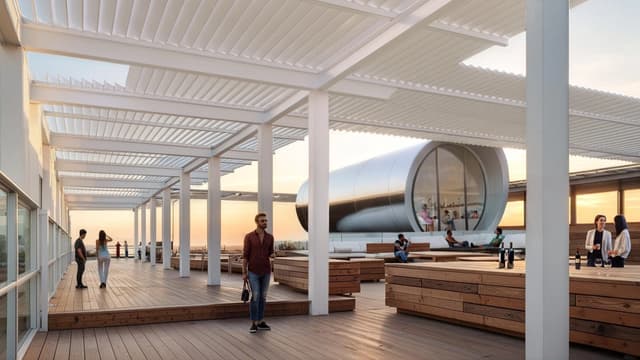
MIT · 威尼托大区 · CAV协议
Hyperbuilders · Webuild + Leonardo
可行性评估积极
CAV在慕尼黑的演示
设计仍取决于启动和资金
Hyperworks’ role
01 / 03
Hyperworks(当时为 Hyperloop Italia)在意大利推广了该项目,建立了机构和工业关系,并帮助组建了后来成为 Hyperbuilders 的团体。公共招标将这种势头转化为一个由 CAV 正式治理的计划。
来源透明度:Hyperworks 的发起角色是公司账户;中标、管理和第一阶段结果由 CAV、威尼托大区和项目来源记录在案。
Hyperbuilders + public governance
Promotion and coordination
Promoted the project in Italy and the industrial coalition later formalised as Hyperbuilders. This originating role is reported as Hyperworks’ company history.
Contracting authority and PPMO
Concessioni Autostradali Venete led the innovation partnership, operational management and publication of the results.
Public management
They sit with CAV on the Technical Committee and define the institutional and funding framework for later phases.
Hyperbuilders consortium
A global infrastructure leader and a major aerospace, defence and complex-systems group: together they won the tender and delivered Phase 1.
Integration and certification
The FS Group companies supported system integration, railway engineering and the route toward approval and certification.
Technical-scientific expertise
Supported the PPMO and produced independent expert assessments of technology maturity and transferability.
Appointed designers
Design, engineering, quality assurance and hyperloop technology capabilities integrated into the feasibility assessment.
Technology and research
Thyssenkrupp, PROSE, WayAssauto and the Milan, Turin and Bari polytechnic universities contributed specialist expertise.
可行性研究 · 摘要
Phase 1 was a full feasibility assessment, run by the Hyperbuilders consortium under contracting authority CAV and closed with a positive outcome. This is a summary of how it was organised, against which criteria, and what it established.
To verify the feasibility of designing, building and testing an ultra-fast, magnetically levitated, low-energy transport system, laying the basis for an innovative, sustainable and commercially competitive transport mode.
The innovation partnership brought together the public side (MIT, Veneto Region, CAV) and industrial capability (Webuild–Leonardo) in a collaborative model, with a PPMO run by CAV and the University of Padua, a Technical Committee, and Italferr and Italcertifer as system integrators.
Eight technical groups covering vehicles, infrastructure, system integration, certification and approval, and stations; four management groups covering economics, multidisciplinary coordination and intellectual property; weekly meetings and workshops with CAV’s PPMO. The work spanned eight countries and over 1,000 hours of conference calls.
Wherever possible, select technologies that are already commercially available, tested or designed and obtainable without proprietary patents or licences. This lowers technology risk and ties the system to verifiable components.
Every subsystem was assessed on NASA-derived TRL (1–9) and MRL (1–10) scales. The largest challenges remain ultra-high speed in vacuum, thermal-exchange management, the capsule’s enclosed environment and continuous data-transmission requirements.
Some of the technologies developed already improve existing high-speed systems in the medium term: inverters, braking and cooling systems, communication and signalling, aerodynamics and on-board energy sources.
Completed with a positive outcome on 12.11.24
Subject to activation and funding
Construction of the Test Track (pilot route)
CAV public data · Phase 1
Hyperworks 编辑摘要,基于 CAV 公开的结果。这些数字描述的是研究和拟议系统,而非已建造的基础设施。
约 10 公里高架测试轨道,单条双向管道,自动运行,初始参考压力为 50 帕,将在设计阶段确认。
测试轨道目标速度为 630 公里/小时;舱体可容纳 38 名乘客或 12 吨货物。1,000 公里/小时仅作为未来商业路线的目标陈述。
安全管理计划、初步危害登记册、疏散开口、区段隔离以及初始要求与标准矩阵。
真空中的超高速、热交换、舱体封闭环境、长轨道上的连续数据传输和泵送序列。
CAV 的能源对比是一个针对假设 250 公里路线的初步模型,声明置信水平为 70%,将在设计阶段验证。
Transport assessment
汽车通常更具竞争力;Hyper Transfer在拥堵高峰时段对独行旅客更具优势。
高速铁路领先。当年旅客量超过400万且低于航空时,Hyper Transfer变得具有可比性。
当每对起讫点年旅客量超过400-500万时,Hyper Transfer成为最具竞争力的选择。
航空通常领先;当年旅客量超过400-500万时,Hyper Transfer对用户更具优势。
模拟比较了汽车、高速铁路、航空和意大利背景下假设的商业 Hyper Transfer 系统。它们不是需求或盈利预测。
Project film · Italian
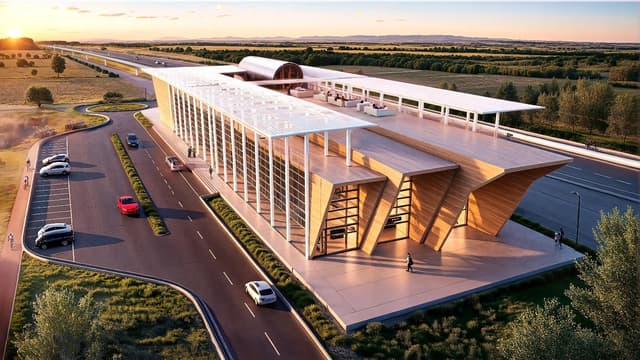
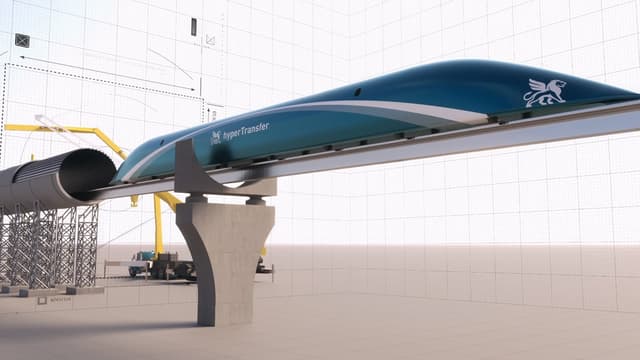
影片通过现场镜头和概念可视化展示了计划、多学科工作和测试轨道愿景。
照片级真实序列是项目可视化,而非现有 Hyper Transfer 基础设施的镜头。
Open results · CAV
Data and presentation published by CAV · PDF · 3.5 MB
English version of the results published by CAV · PDF · 2.1 MB
Hyperworks 提供提供的出版物副本。知识产权、数据和结果仍归属于 CAV 和项目治理。
Verified status · 28 Jul 2026
03 / 03
第一阶段以积极结果结束。下一步是原型和认证轨道的设计。根据 CAV 文件,第二和第三阶段的启动仍取决于前一阶段的成功以及实际资金,国家和欧洲资金来源仍有待确定。
Hyperworks 已准备好支持计划的连续性,但测试轨道尚未获得资金、签约或建造。