Objective of the study
To verify the feasibility of designing, building and testing an ultra-fast, magnetically levitated, low-energy transport system, laying the basis for an innovative, sustainable and commercially competitive transport mode.

HyperTransfer · Veneto, Italy
A Hyperworks promoveu o Hyper Transfer na Itália e a formação da coalizão industrial que se tornou Hyperbuilders. O consórcio Webuild–Leonardo então venceu a licitação da CAV e completou a primeira das três fases do programa.
Explore the results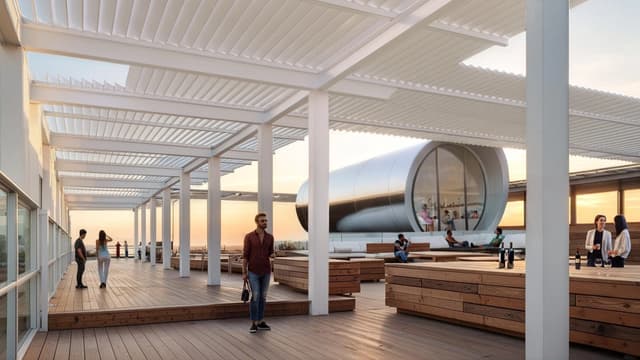
MIT · Região do Veneto · Protocolo CAV
Hyperbuilders · Webuild + Leonardo
Avaliação de viabilidade positiva
Apresentação CAV em Munique
O design permanece sujeito a ativação e financiamento
Hyperworks’ role
01 / 03
A Hyperworks, então Hyperloop Italia, promoveu o projeto na Itália, construiu relações institucionais e industriais e ajudou a formar o grupo que se tornou Hyperbuilders. A licitação pública transformou esse impulso num programa formalmente governado pela CAV.
Transparência de fonte: o papel originário da Hyperworks é uma conta de empresa; a adjudicação, gestão e resultados da Fase 1 estão documentados pela CAV, Região do Vêneto e fontes do projeto.
Hyperbuilders + public governance
Promotion and coordination
Promoted the project in Italy and the industrial coalition later formalised as Hyperbuilders. This originating role is reported as Hyperworks’ company history.
Contracting authority and PPMO
Concessioni Autostradali Venete led the innovation partnership, operational management and publication of the results.
Public management
They sit with CAV on the Technical Committee and define the institutional and funding framework for later phases.
Hyperbuilders consortium
A global infrastructure leader and a major aerospace, defence and complex-systems group: together they won the tender and delivered Phase 1.
Integration and certification
The FS Group companies supported system integration, railway engineering and the route toward approval and certification.
Technical-scientific expertise
Supported the PPMO and produced independent expert assessments of technology maturity and transferability.
Appointed designers
Design, engineering, quality assurance and hyperloop technology capabilities integrated into the feasibility assessment.
Technology and research
Thyssenkrupp, PROSE, WayAssauto and the Milan, Turin and Bari polytechnic universities contributed specialist expertise.
Estudo de viabilidade · resumo
Phase 1 was a full feasibility assessment, run by the Hyperbuilders consortium under contracting authority CAV and closed with a positive outcome. This is a summary of how it was organised, against which criteria, and what it established.
To verify the feasibility of designing, building and testing an ultra-fast, magnetically levitated, low-energy transport system, laying the basis for an innovative, sustainable and commercially competitive transport mode.
The innovation partnership brought together the public side (MIT, Veneto Region, CAV) and industrial capability (Webuild–Leonardo) in a collaborative model, with a PPMO run by CAV and the University of Padua, a Technical Committee, and Italferr and Italcertifer as system integrators.
Eight technical groups covering vehicles, infrastructure, system integration, certification and approval, and stations; four management groups covering economics, multidisciplinary coordination and intellectual property; weekly meetings and workshops with CAV’s PPMO. The work spanned eight countries and over 1,000 hours of conference calls.
Wherever possible, select technologies that are already commercially available, tested or designed and obtainable without proprietary patents or licences. This lowers technology risk and ties the system to verifiable components.
Every subsystem was assessed on NASA-derived TRL (1–9) and MRL (1–10) scales. The largest challenges remain ultra-high speed in vacuum, thermal-exchange management, the capsule’s enclosed environment and continuous data-transmission requirements.
Some of the technologies developed already improve existing high-speed systems in the medium term: inverters, braking and cooling systems, communication and signalling, aerodynamics and on-board energy sources.
Completed with a positive outcome on 12.11.24
Subject to activation and funding
Construction of the Test Track (pilot route)
CAV public data · Phase 1
Resumo editorial da Hyperworks dos resultados tornados públicos pela CAV. Os números descrevem o estudo e o sistema proposto, não infraestrutura já construída.
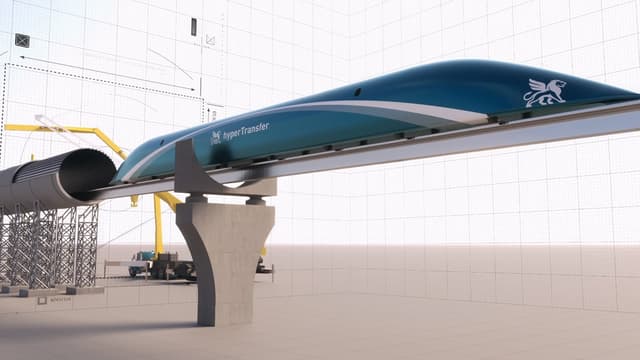
Aproximadamente 10 km de pista de teste elevada, tubo bidirecional único, operação automática e uma pressão de referência inicial de 50 Pa a ser confirmada durante o projeto.
Um alvo de 630 km/h na pista de teste; cápsulas para 38 passageiros ou 12 toneladas de carga. 1.000 km/h declarado apenas como objetivo futuro de rota comercial.
Plano de gestão de segurança, registo preliminar de perigos, aberturas de evacuação, isolamento de secções e uma matriz inicial de requisitos e normas.
Ultra-alta velocidade no vácuo, troca térmica, o ambiente fechado da cápsula, transmissão contínua de dados e sequências de bombagem num trilho longo.
A comparação de energia da CAV é um modelo preliminar para uma rota hipotética de 250 km, com um nível de confiança declarado de 70%, a ser validado durante a fase de projeto.
Transport assessment
Os carros continuam geralmente mais competitivos; o Hyper Transfer melhora para viajantes individuais durante as horas de ponta congestionadas.
A ferrovia de alta velocidade lidera. O Hyper Transfer torna-se comparável acima de 4 milhões de passageiros anuais e inferior ao aéreo.
O Hyper Transfer emerge como a opção mais competitiva acima de 4-5 milhões de passageiros anuais por par origem-destino.
O aéreo lidera em geral; acima de 4-5 milhões de passageiros anuais o Hyper Transfer torna-se mais vantajoso para os utilizadores.
As simulações comparam carros, trem de alta velocidade, avião e um sistema comercial hipotético de Hyper Transfer no contexto italiano. Não são uma previsão de procura ou rentabilidade.
Project film · Italian
O filme apresenta o programa, o trabalho multidisciplinar e a visão da pista de teste através de imagens ao vivo e visualizações conceituais.
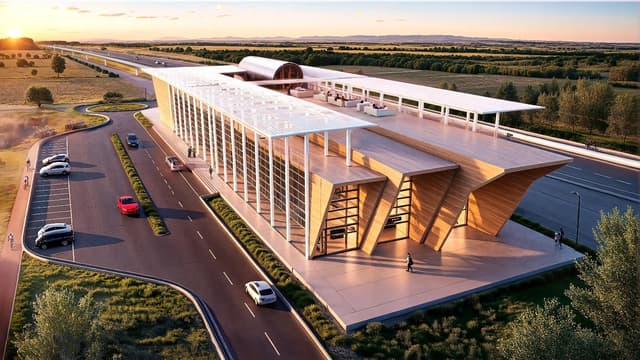
As sequências fotorrealistas são visualizações de projeto, não imagens de infraestrutura existente do Hyper Transfer.
Open results · CAV
Data and presentation published by CAV · PDF · 3.5 MB
English version of the results published by CAV · PDF · 2.1 MB
A Hyperworks disponibiliza as cópias da publicação fornecida. A propriedade intelectual, dados e resultados permanecem atribuídos à CAV e à governança do projeto.
Verified status · 28 Jul 2026
03 / 03
A Fase 1 terminou positivamente. O próximo passo é o projeto dos protótipos e da pista de certificação. De acordo com os documentos da CAV, a ativação das Fases 2 e 3 permanece sujeita à fase anterior bem-sucedida e ao financiamento real, com fontes nacionais e europeias ainda a serem identificadas.
A Hyperworks está pronta para apoiar a continuidade do programa, mas a pista de teste não está financiada, contratada ou construída.