
Italy focus · 2026
Hyperloop in Italy: the state of the projects.
HyperTransfer has completed its feasibility phase; financing the test track is the next step. Here you can find the programme status, the organisations involved and the documented facts.
HyperTransfer
What HyperTransfer is.
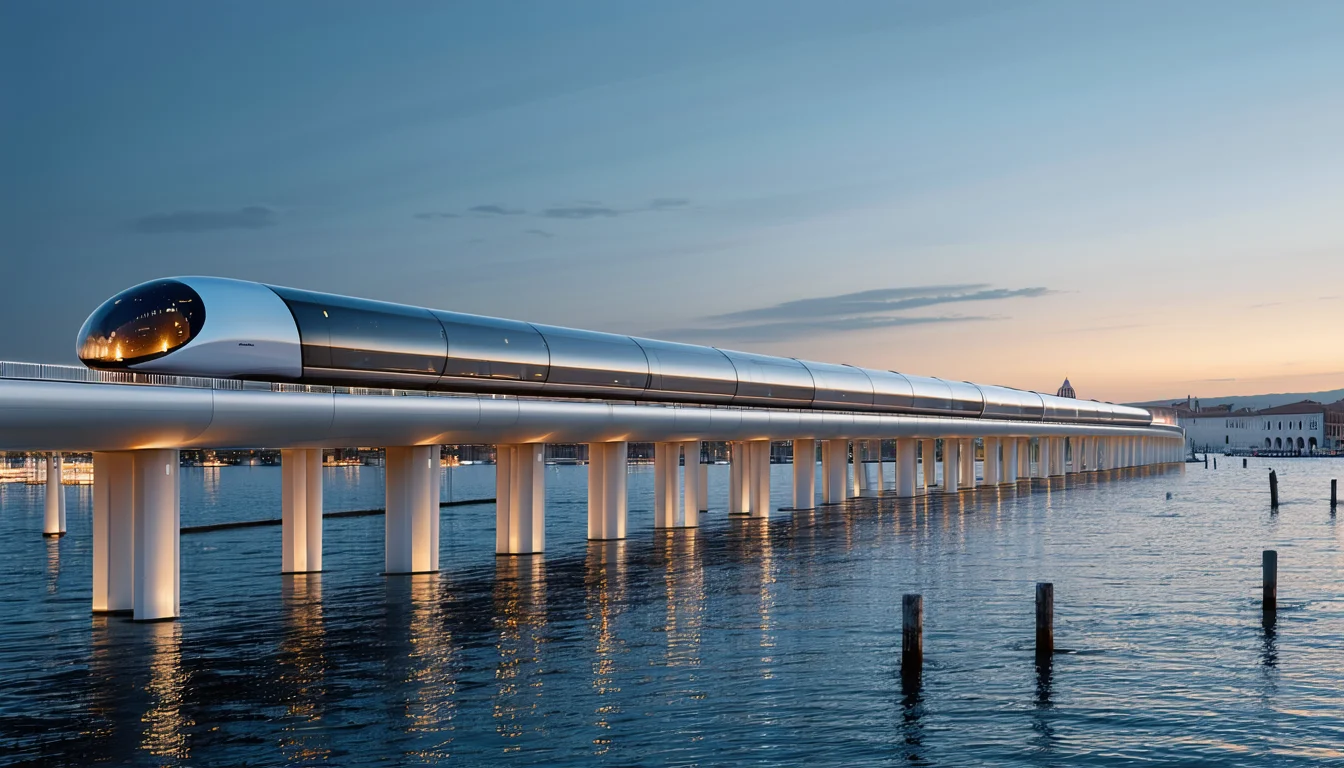
HyperTransfer is the hyperloop programme for the corridor between Padua and Venice-Mestre in the Veneto region. It was set up as an innovation partnership, a public procurement instrument that brought the Ministry of Infrastructure and Transport, the Veneto Region and CAV (Concessioni Autostradali Venete) together with the industrial capabilities of the Hyperbuilders consortium.
The objective of Phase 1 was to verify the feasibility of designing, building and testing an ultra-fast, magnetically levitated, low-energy transport system, laying the basis for an innovative, sustainable and commercially competitive transport mode. The guiding criterion: select, wherever possible, technologies already commercially available, without proprietary patents or licences.
The documented partners
Who worked on it.
The Hyperbuilders consortium of Webuild and Leonardo won the tender and delivered Phase 1. Italferr and Italcertifer, both FS Group companies, covered system integration, railway engineering and the route toward approval and certification. The University of Padua supported the PPMO with independent assessments of technology maturity.
Hyperworks, RINA and HyperloopTT were the appointed designers; Thyssenkrupp, PROSE, WayAssauto and the Milan, Turin and Bari polytechnic universities contributed specialist expertise. The work mobilised 50,000 engineering hours, 60 FTEs, over 5,000 pages produced and 20 nationalities across 8 countries.
Honest status
From feasibility to design.
Phase 1 closed with a positive outcome on 12 November 2024, and CAV published the results on 3 June 2025 together with the proposed next step: a certification test track of about 10 km. Phase 2, design, is subject to activation and funding; Phase 3 is the construction of the test track. Today neither is funded.
This is the precise meaning of “feasibility completed”: the technical and economic case holds up to public scrutiny, but the decision to invest has not been taken yet. It is a distinction that matters, and we keep it explicit in every communication.
The European context
A European ecosystem in motion.
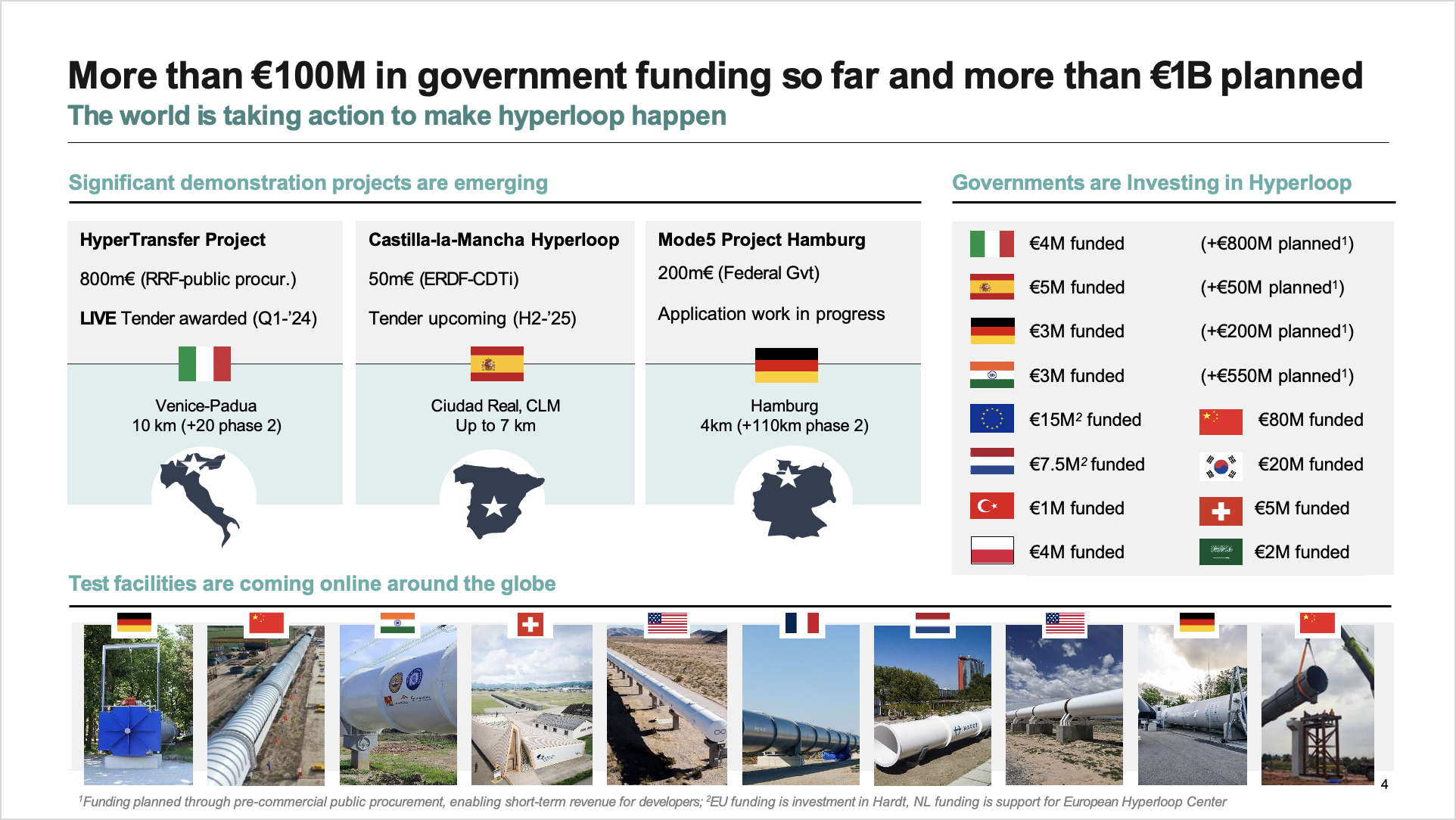
In the Netherlands, the European Hyperloop Center operates a 420 m test tube in Veendam with a full lane switch, open to different hyperloop systems. Also in Veendam, from 13 to 19 July 2026, European Hyperloop Week brought together university teams from around the world with vehicles and full-scale pods.
At EU level, Hyper4Rail is defining a common hyperloop concept, interoperability rules and an industrial roadmap. The Horizon Europe proposal HyperSafe has been selected for Grant Agreement Preparation; Hyperworks leads the work package on control, command and signalling validation. In Poland, Nevomo’s Magrail tests demonstrated maglev levitation on existing railway track, an adjacent technology that can be integrated as a subsystem.
Track active programmes worldwideHyperworks’ role
Who we are in this story.
Hyperworks promoted the project in Italy and the industrial coalition later formalised as Hyperbuilders, taking part in Phase 1 as an appointed designer. Since 2025 we have operated as an independent developer and integrator, free to choose the technologies and suppliers best suited to each corridor. Our headquarters are in Milan, Via Seprio 2.
The Global Observatory tracks the programme and the wider ecosystem, record by record, with a source and verification date. Companies, research centres and institutions can contribute through the dedicated channel.
FAQ
Frequently asked questions.
Is there a hyperloop in Italy already?
No. No hyperloop line or test track has been built in Italy. What exists is a completed and validated public feasibility assessment for the HyperTransfer corridor between Padua and Venice-Mestre, published by CAV in June 2025, and a proposal for a test track of about 10 km that still awaits activation and funding.
Is the 10 km test track funded?
No. The published phasing is explicit: Phase 1, the feasibility assessment, was completed with a positive outcome on 12 November 2024. Phase 2 (design) is subject to activation and funding, and Phase 3 covers construction of the test track. Announcing a completed study is not the same as opening a construction site.
Who leads the HyperTransfer programme?
The contracting authority is CAV (Concessioni Autostradali Venete), which ran the innovation partnership and published the results. The Ministry of Infrastructure and Transport and the Veneto Region sat on the Technical Committee. The Hyperbuilders consortium of Webuild and Leonardo delivered Phase 1, with Italferr and Italcertifer covering integration and certification and the University of Padua providing independent technical assessment.
When will passengers be able to ride it?
There is no public date, and anyone quoting one is speculating. The documented roadmap is feasibility, then design, then a test track for prototyping and certification. A passenger service would come only after those phases are funded, built and certified.
How can I follow or contribute?
The Hyperworks Global Observatory publishes the verified status of HyperTransfer and of every other active programme, with source and verification date. Companies, researchers and institutions that want to contribute to the ecosystem can use the contribute page or write to Hyperworks directly.