
The essential guide
What is hyperloop?
An electric capsule travels by magnetic levitation inside a low-pressure tube. Here we explain how it works, where it is being tested and which steps lead to the first commercial lines, always with verifiable sources.
The principle
Taking the air out of the journey.
A high-speed train spends much of its energy pushing air out of its way. Hyperloop removes the problem at the root: the vehicle travels inside a tube where the pressure is reduced, levitates magnetically instead of rolling on wheels and is driven by linear motors built into the guideway.
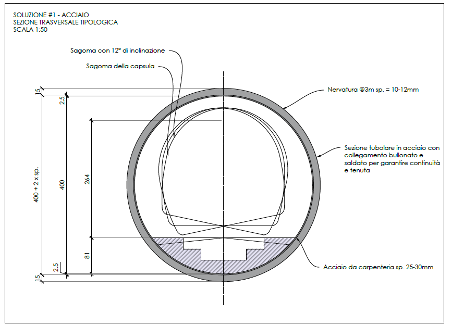
Every hyperloop system combines six interdependent layers: guideway, low-pressure environment, levitation and guidance, propulsion, vehicle and control.
The origins
Older than the name.
The idea of moving vehicles through a tube is more than two centuries old: George Medhurst patented atmospheric transport in 1799, and in the nineteenth century some atmospheric railways even entered public service, held back by sealing problems and costs. In 1904 Robert Goddard sketched a magnetically suspended train in an evacuated tube.
On 12 August 2013, the 58-page open Hyperloop Alpha document reset the global conversation by bringing together low-pressure tubes, aerodynamic pods, linear propulsion and a Los Angeles–San Francisco case. The 2015 SpaceX competition mobilised universities worldwide; European Hyperloop Week has carried that work forward since 2021.
Read the full historyThe real status
Where testing happens.
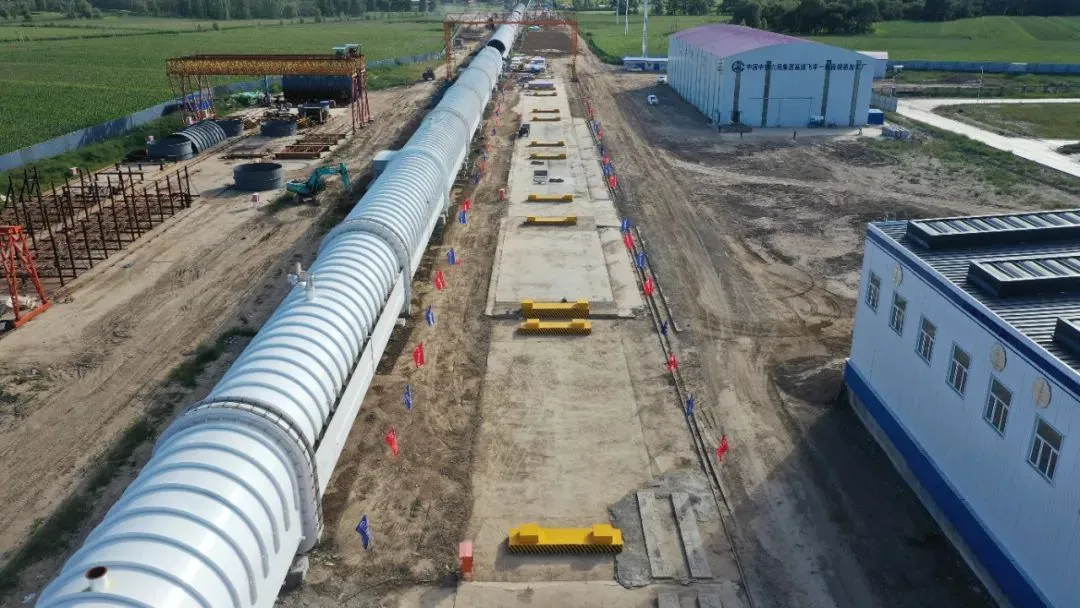
The European Hyperloop Center in Veendam, the Netherlands, operates a 420 m test tube with a full lane switch. In India, IIT Madras and TuTr completed a 422 m track with first runs at 100 km/h. In China, the T-Flight programme runs full-scale maglev vehicles in a 2 km low-vacuum tube, with a declared target of 1,000 km/h.
In 2023 the Technical University of Munich’s 24 m full-scale demonstrator carried passengers under vacuum after TÜV Süd approval. In May 2026 Swisspod’s AERYS 1 capsule reached 146 km/h at the Pueblo test track, the most recent public record.
See all verified projectsTechnical honesty
What is still missing.
The first commercial line is the sector’s next milestone. Public feasibility studies identify the remaining challenges: ultra-high speed in vacuum, thermal exchange, the capsule’s enclosed environment and continuous data transmission. Virgin Hyperloop carried its first passengers in 2020 and closed at the end of 2023 without a construction contract. The decisive challenge is the full programme: civil works, certification, finance and public support.

In Europe the EU-backed Hyper4Rail project is defining a common hyperloop concept, interoperability rules and an industrial roadmap: the route toward a certifiable system runs through there.
Browse the public studiesThe Italian case
And in Italy?
Italy has one of the most documented public programmes: HyperTransfer, the corridor between Padua and Venice-Mestre. The feasibility assessment is completed and validated, published by CAV in June 2025; the proposed next step is a test track of about 10 km, still subject to activation and funding.
The state of projects in ItalyFAQ
Frequently asked questions.
Does hyperloop exist today?
As test infrastructure, yes; as a transport service, no. Facilities such as the 420 m European Hyperloop Center tube in Veendam, the 422 m track at IIT Madras and the 2 km low-vacuum T-Flight tube in Shanxi run real tests. Nowhere in the world can you buy a ticket for a hyperloop ride.
How fast is hyperloop?
The fastest verified public result is 146 km/h, reached by Swisspod’s AERYS 1 capsule at the Pueblo test track in 2026. Programmes like China’s T-Flight state targets up to 1,000 km/h, but a target is not a test result. Short tubes physically limit top speed: real performance figures will come from longer tracks.
Who invented hyperloop?
The modern concept was popularised by the open Hyperloop Alpha document of August 2013, but the idea is much older: George Medhurst patented atmospheric tube transport in 1799, and Robert Goddard sketched a magnetically suspended vacuum-tube train in 1904.
Is hyperloop the same as maglev?
No. Magnetic levitation removes wheel friction; hyperloop adds a low-pressure tube around the vehicle to remove most air resistance as well. The two are complementary: Nevomo’s Magrail tests, for example, show maglev running on ordinary railway track, a technology that can become a hyperloop subsystem.
Where can I follow real progress?
The Hyperworks Global Observatory tracks verified projects, test facilities and public programmes with source and verification date. The open library collects feasibility studies and public documents, and European Hyperloop Week brings student teams to a real track every year.